When routine network maintenance disrupts an entire nation’s airspace, the conversation goes beyond aviation. It’s about network reliability, infrastructure resilience, and knowing what’s happening before the consequences escalate.
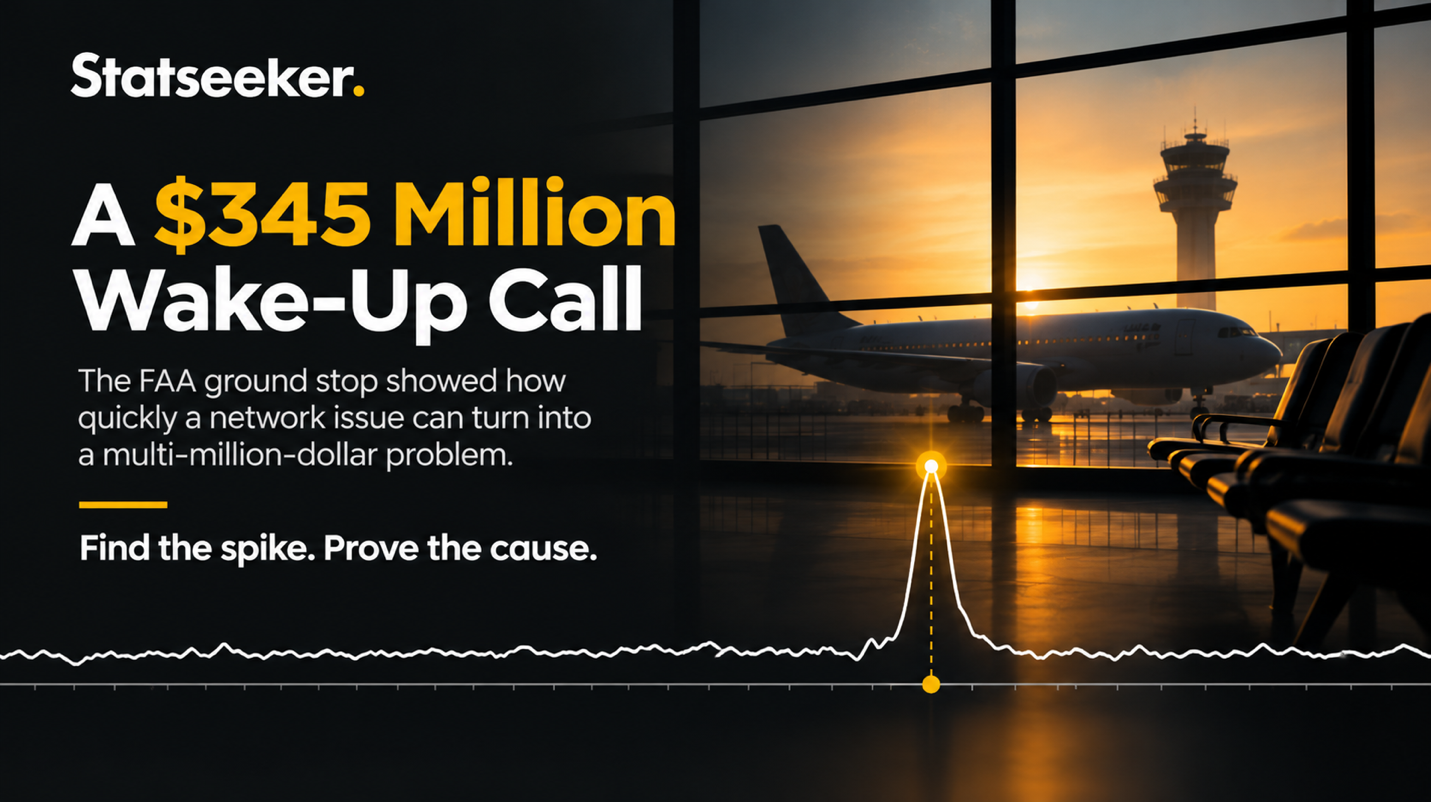
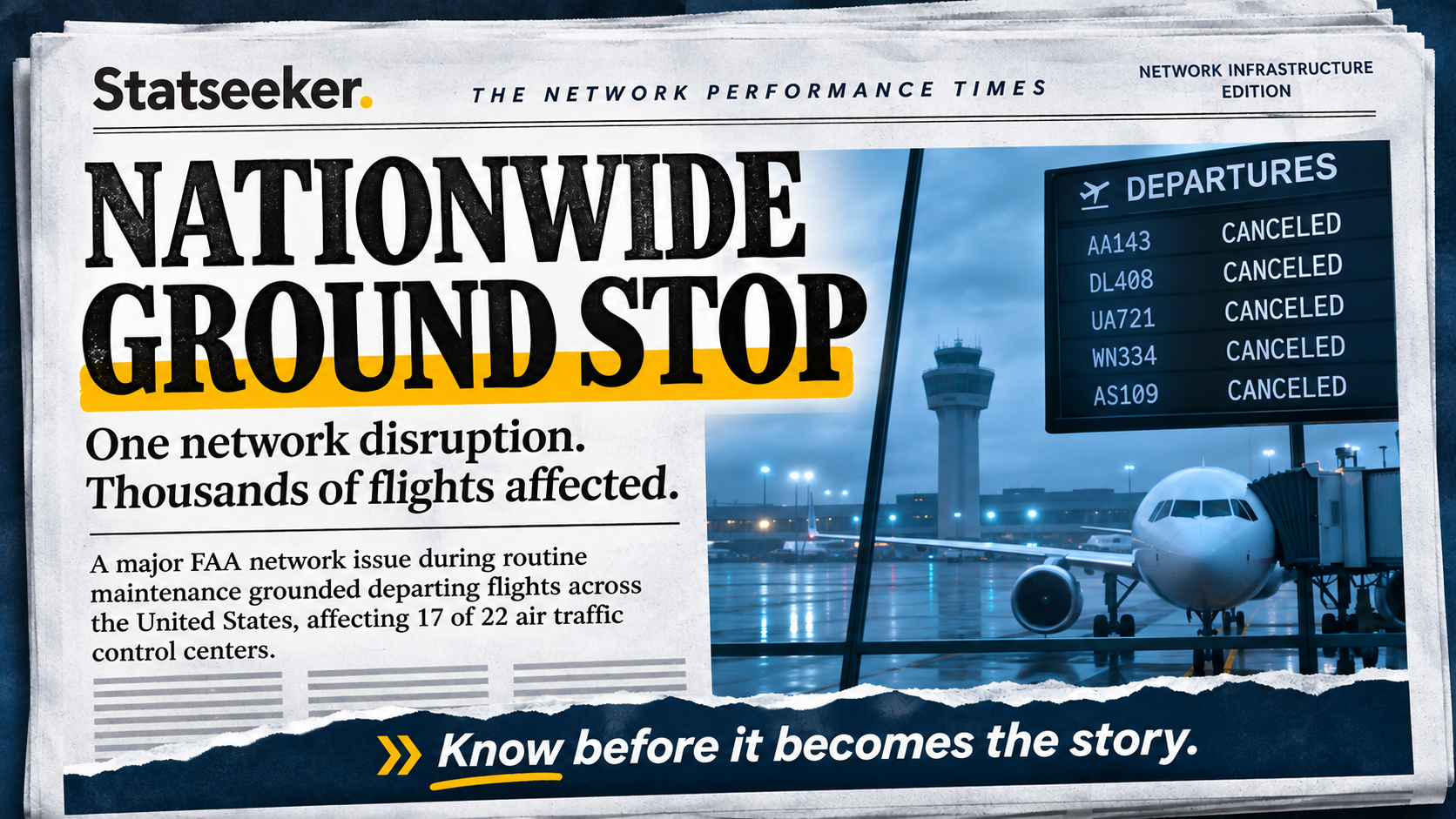
On November 13, 2026, thousands of flights across the United States were grounded following a major telecommunications disruption affecting the Federal Aviation Administration (FAA).
For travelers, it meant canceled flights, missed connections, and hours of uncertainty.
For network professionals, the technical details tell a different story. One about aging infrastructure, network instability, and how quickly problems can spread across interconnected systems.
And it raises an important question: How much visibility do organizations really have into their networks before something goes wrong?
What happened to the FAA’s network?
According to the FAA, the incident began amid routine telecommunications maintenance involving a transition from legacy copper connections to fiber-optic infrastructure.
Investigators identified excessive connection activity originating from two potential locations, including a site where a new router had been deployed.
At its peak, the network experienced approximately 1,000 connection attempts every four to five seconds.
The resulting instability affected communications and radar feeds at 17 of the FAA’s 22 regional air traffic control centers.
The FAA issued a nationwide ground stop as a safety precaution. Normal flight departures began resuming after the network stabilized, but the disruption had already affected thousands of flights.
The precise root cause remains under investigation.
When a routine network change becomes a national disruption
Network upgrades happen every day.
Routers are replaced. Connections are migrated. Infrastructure is modernized. Most of the time, these changes happen without anyone outside IT noticing.
But complex networks are interconnected, and an issue originating at one location can affect systems far beyond that location.
The FAA incident illustrates how quickly a seemingly localized technical problem can become an operational crisis.
It also highlights why network visibility cannot begin only after users report that something is wrong.
What network performance monitoring brings to the conversation
Effective network performance monitoring is about more than knowing whether a device is online.
It’s about understanding how infrastructure behaves over time, recognizing changes in performance, and having the historical evidence needed to investigate incidents.
For network engineering teams, three capabilities are especially important.
1. Detect changes in network behavior
Unusual traffic patterns, interface utilization, errors, and performance deviations can provide early indicators of network trouble.
Frequent monitoring helps teams recognize changes before they develop into more serious operational problems.
2. Prove what happened
When an incident occurs, engineers need evidence.
Historical performance data helps establish timelines, identify affected interfaces, compare conditions before and after a change, and investigate potential contributing factors.
Without sufficient historical detail, troubleshooting can become a process of reconstructing events from incomplete information.
3. Prevent recurring problems
Not every outage is preventable. However, understanding previous incidents helps teams identify vulnerabilities, improve change management, validate infrastructure upgrades, and reduce the likelihood of similar disruptions.
The goal isn’t simply to restore service. It’s to learn enough from the incident to strengthen the network.
Why historical network data matters
One of the most difficult questions following a major incident is often the simplest:
What changed?
Was there a sudden increase in traffic? Did an interface begin reporting errors? Was performance deteriorating before maintenance began? Did the problem spread to other parts of the network?
Answering these questions requires reliable historical information.
Statseeker provides 60-second SNMP polling, one-second diagnostic capabilities, and unlimited unaveraged historical performance data, helping network teams investigate performance changes without losing detail through data averaging.
These capabilities support the broader objective of understanding network behavior before, during, and after an incident.
Of course, no monitoring platform can guarantee that every failure will be detected or prevented. The FAA’s investigation has not established whether additional monitoring could have prevented this particular event.
But the importance of accurate, accessible network performance evidence is difficult to overlook.
The bigger lesson: Know before it becomes the story
The FAA incident made international headlines because the consequences extended far beyond the network itself.
That’s often how critical infrastructure failures become visible to the public.
People don’t see routers, interfaces, polling intervals, or historical performance data.
They see grounded aircraft, unavailable services, interrupted operations, and the consequences of systems that aren’t performing as expected.
For network professionals, the objective is to understand the infrastructure before those consequences become the headline.
Detect. Prove. Prevent.
Because the best time to understand what is happening on your network is before everyone else is asking what went wrong.
Learn how Statseeker helps organizations monitor network performance, investigate incidents, and maintain visibility into critical infrastructure.